

Where others look away, we lean in

ONEKID Foundation Logo
ONEKID PROGRAMS

Programs built for the places children actually are.

ONEKID develops practical safeguarding programs for the organizations, professionals, and environments positioned to notice risk early, reduce opportunity, and act when something does not look right.

PRACTICAL PREVENTION

Safety has to work in the real environment.

Policies matter. Training matters. Background checks matter. But protection is ultimately tested in the ordinary moments where people enter buildings, move through hallways, supervise children, exchange information, hand off responsibility, and decide whether something unusual deserves attention.

Those moments look different in a hotel, a school, a church, a clinic, a youth organization, or a residential environment. A generic checklist cannot account for every circumstance.

ONEKID programs are designed around the actual environment: who has access, where visibility is lost, how responsibility changes hands, what staff are positioned to observe, how concerns are escalated, and what happens after someone raises a concern.

The objective is not simply to tell people to be more aware. It is to make the environment harder to misuse.

FROM POLICY TO PRACTICE

Start with the environment.

Effective safeguarding begins by understanding where people, access, responsibility, privacy, supervision, and routine intersect. We look at how the organization actually operates, identify circumstances that create unnecessary opportunity, and build controls around the places where risk can emerge.

HOW WE BUILD

A program should change what happens on an ordinary day.

The standard is operational, not theoretical.

Training has value when people understand what they are expected to notice and what authority they have when something happens. Policy has value when the environment makes the policy practical to follow.

Our programs bring those pieces together so prevention is built into routine operations instead of depending entirely on someone recognizing danger after it has already developed.

01 Assess Understand the physical environment, normal workflow, access points, responsibilities, and circumstances unique to the organization.
02 Reduce Opportunity Identify situations where misconduct, exploitation, unauthorized access, or unsafe contact could occur without sufficient visibility or accountability.
03 Establish Controls Build practical procedures around access, supervision, custody, communication, documentation, and escalation.
04 Prepare People Give staff clear indicators, expectations, reporting paths, and decision authority appropriate to their role.
05 Review Revisit controls as environments, staffing, technology, operations, and observed risks change.
CURRENT PROGRAMS

Different environments create different opportunities.

ONEKID programs are developed around the realities of specific sectors rather than forcing every organization into the same safeguarding model. Each environment changes what people can observe, how access works, where responsibility changes hands, and which controls are practical.

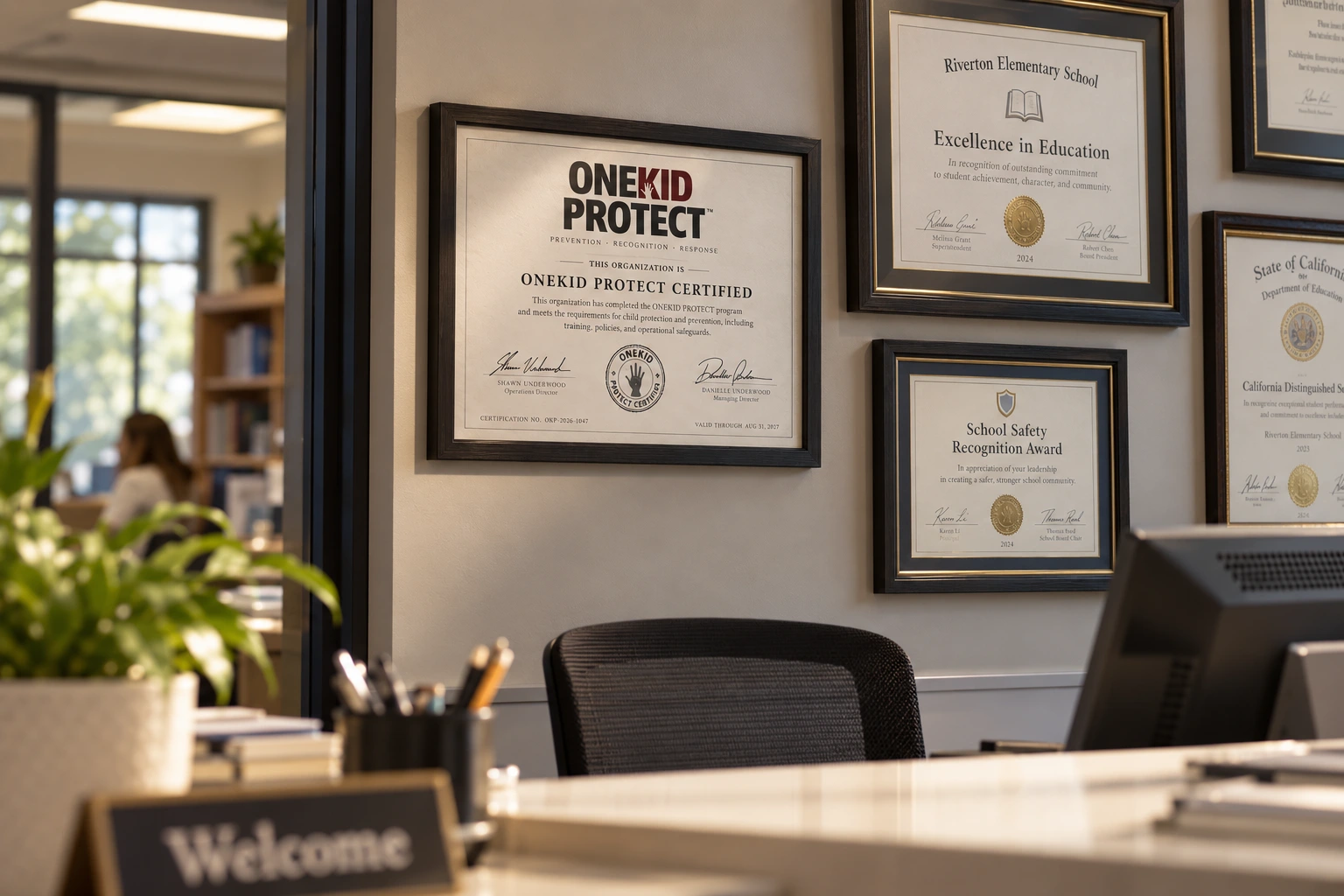
ONEKID PROTECT certification displayed in an organizational setting
ONEKID PROTECT

A child protection standard organizations can put into practice.

ONEKID PROTECT brings training, operational safeguards, and certification together into a practical child protection program.

Designed for schools, churches, hotels, youth organizations, and other environments positioned to protect children, PROTECT prepares people to recognize risk, reduce unnecessary opportunity, and respond when something does not look right.

Qualifying organizations can earn PROTECT Certification, documenting completion of applicable training and adoption of the safeguards and procedures established by ONEKID.

Explore ONEKID PROTECT
Hotel staff working in a guest environment
01 HOSPITALITY

See what routine can hide.

Hotels and lodging environments bring together transient guests, privacy, multiple entrances, short stays, service staff, contractors, and activity across every hour of the day. Front desk, housekeeping, security, and management can each see a different part of the picture.

Pattern Recognition Escalation Incident Documentation Staff Coordination
Explore Hospitality
School staff managing a controlled family check-in
02 SCHOOLS & CHILDCARE

Build safety into the ordinary day.

Safeguarding in schools and childcare environments depends on more than who is hired. Access, supervision, private spaces, technology, visitor controls, transportation, pickup procedures, reporting, and clear custody rules all shape the environment children move through every day.

Access Control Supervision Pickup & Custody Staff Accountability
Explore Schools & Childcare
BUILT AROUND THE ORGANIZATION

The environment determines the safeguards.

Two organizations in the same sector can operate very differently. Building layout, staffing model, hours, technology, population served, transportation, volunteers, public access, and internal culture all affect what a practical safeguarding system should look like.

That means program development may include more than a training session. It can involve reviewing procedures, identifying gaps, adjusting access or supervision models, strengthening documentation, establishing escalation paths, or helping leadership define exactly who is responsible when something occurs.

The goal is not to make the organization look more secure. The goal is to make unsafe circumstances harder to create.

01

Physical Environment

Entry points, private areas, sightlines, shared spaces, transportation zones, restricted areas, and places where supervision naturally decreases.

02

Procedures & Authority

Who can access what, who is responsible for whom, how exceptions are handled, and what authority staff have when something does not look right.

03

People & Accountability

Hiring, volunteers, supervision, documentation, reporting, escalation, handoffs, and the controls that remain in place regardless of familiarity.

WORKING WITH ORGANIZATIONS

Protection works better when it is designed before the incident.

ONEKID works with organizations that want to strengthen safeguarding before a crisis forces the issue. That can begin with a specific concern, a policy review, a new facility, a recurring operational challenge, or simply leadership asking a useful question: where are we relying on trust when we should be relying on structure?

We start with the environment, identify what can realistically be improved, and build from there.

BUILD A SAFER ENVIRONMENT

Start with the places where opportunity still exists.

If your organization is responsible for children, families, guests, employees, or vulnerable populations, we can help evaluate the environment and determine where stronger safeguards may make sense.

Discuss a Program